

I get asked this almost every week, usually by a parent sitting across the table while their kid waits outside, pretending not to listen. "Is graphic design even a real career, or is this a phase?" Fair question. You're about to put in money and months on a skill nobody's paid you for yet, so you deserve a real answer, not a sales pitch.
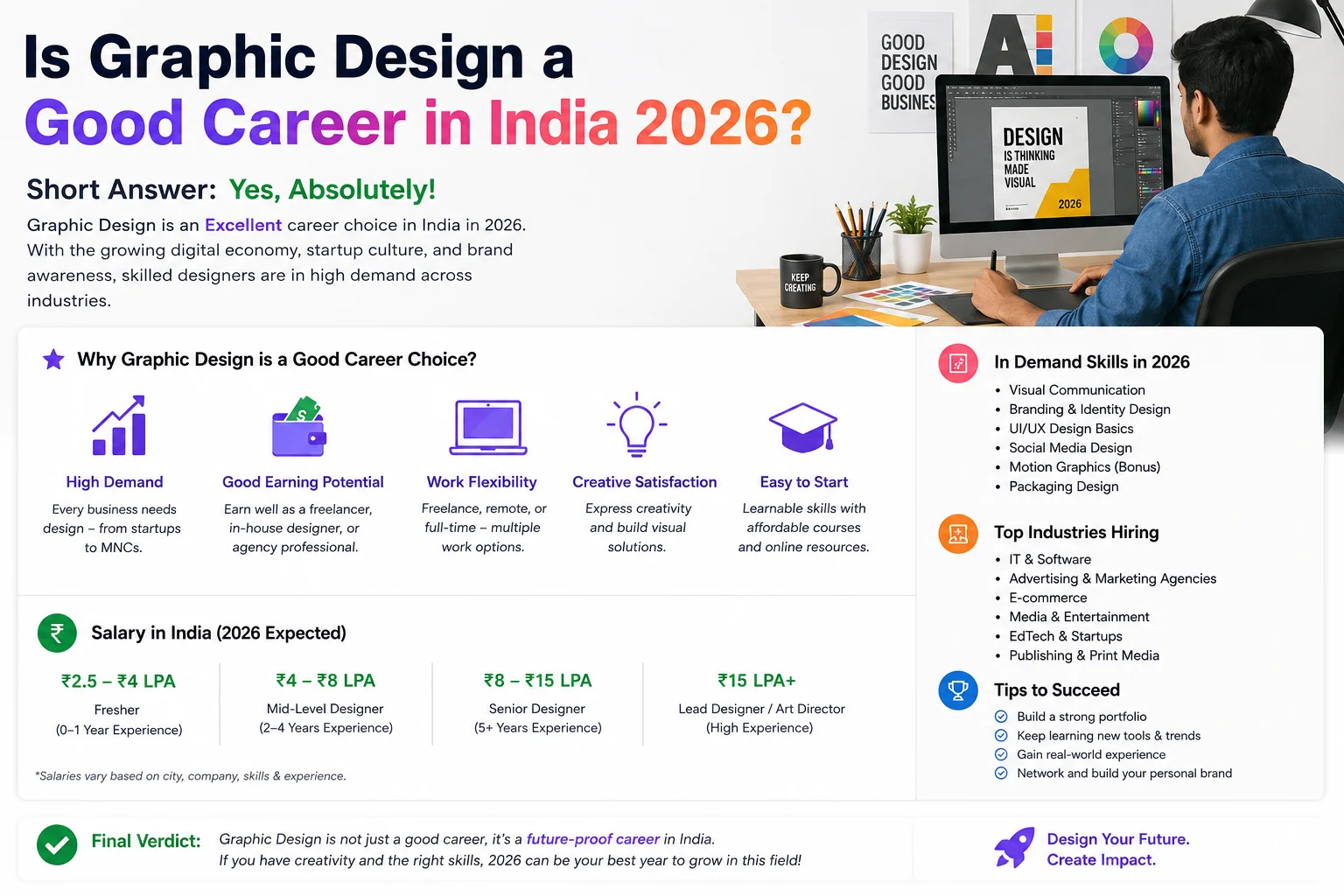
So here's the answer without the gloss: yes, the graphic design career path in India is worth it in 2026 - for the right person, under the right conditions. Let me actually walk you through what that means instead of leaving it at a slogan.
The Short Answer - and Why It Won't Satisfy You
Yes. But "yes" by itself is a lazy answer, and you'll figure that out the moment you start job-hunting.
Think about how much of India's economy now runs on screens. Every D2C brand, every ed-tech app, every fintech startup, every Instagram-first business needs someone to make it look like something worth trusting. Packaging, app screens, pitch decks, ad creatives, brand guidelines - none of that work goes away when a company tightens its belt. If anything, it shows up more, because everyone's fighting harder for the same attention.
Now for the part nobody likes hearing: more people are graduating into design every single year, and most of them look the same on paper. A certificate doesn't separate you from anyone anymore. A portfolio that actually shows you can think does. That gap is widening, and whether you end up on the right side of it is mostly up to you.
Where the Jobs Actually Are in India
Five or six years ago, if you wanted a design job, you basically moved to Mumbai or Delhi. That's not really true anymore.
Pune's become a genuinely good place to build a design career, and not by accident - it's got IT companies, agencies, gaming studios, and a growing list of consumer brands, all of whom need someone in-house to make things look right. Bengaluru, Hyderabad, Chennai, Ahmedabad - all active too.
Here's a rough map of who's actually hiring:
- Digital marketing agencies: Lots of work, fast turnaround, and you'll touch a dozen different brand categories in your first year. Not a bad place to cut your teeth as a fresher.
- In-house brand teams: Product companies and e-commerce brands with their own design desk. Generally better pay, more structure, less chaos than an agency.
- Startups: You'll be doing social posts on Monday and a fundraising deck on Thursday. Steep learning curve, but stability is hit or miss.
- Publishing and media houses: Editorial layouts, illustration-heavy work. Smaller niche, but it doesn't dry up.
- Gaming and entertainment studios: Pune and Bengaluru have a real cluster here. You need a very specific kind of portfolio to break in, but it pays well once you're in.
- Freelance and remote work: This has genuinely opened up for mid-level and senior designers - more Indian designers are now billing international clients directly.
Is Demand Growing - or Just Moving?
Let's not dance around this one. Basic print layout, simple photo touch-ups, low-effort logo work - that end of the market is shrinking. Not because some AI took over design, but because the tools got good enough that a non-designer can now bang out something passable in twenty minutes. That's just true, and there's no point sugar-coating it.
What's actually growing is demand for people who think, not just execute. Companies aren't hiring someone to colour inside the lines of a brief anymore - they want someone who reads the brief, pokes holes in it, and comes back with something that solves an actual business problem.
If I had to point you somewhere, I'd say UI/UX, brand identity, motion design, and packaging are where the real, sustained demand is right now. Generalist design work is fine to start with, but specialising in one of these four gives you a much longer runway.
What Designers Actually Earn in India
Most career blogs go vague right here. I won't. This is what designers are realistically taking home across India's metros and tier-1 cities in 2026:
| Career Stage | Experience | Approximate Monthly Pay |
|---|---|---|
| Fresher | 0–1 Year | ₹12,000 – ₹22,000 |
| Junior Designer | 1–3 Years | ₹22,000 – ₹40,000 |
| Mid-Level Designer | 3–5 Years | ₹40,000 – ₹65,000 |
| Senior Designer | 5+ Years | ₹65,000 – ₹1,10,000+ |
| Art Director / Creative Lead | 7+ Years | ₹1,00,000 – ₹1,80,000+ |
Freelancers who've built a steady client list and picked a lane - brand identity, UI, motion, whatever - often clear more than these full-time numbers, especially once international clients are part of the mix.
I won't pretend the starting numbers are exciting. They're not. But the curve from year two onward is steep if you actually keep getting better, which is more than you can say for a lot of entry-level jobs that just flatten out.
Your Portfolio Matters More Than Your Resume, Always
If you remember one thing from this article, make it this: in Indian design hiring, your portfolio does the talking before your resume gets a second glance. I've seen designers with five years of experience get passed over because their portfolio looked tired, and I've seen a fresher with three sharp projects beat out someone with twice the experience.
A good portfolio isn't everything you've ever touched - it's three to five pieces that actually show how you think, not just that you can use software. For a fresher, that might be the strongest work from your course. For someone mid-career, it should show outcomes - a rebrand that moved the needle, a UI that actually shipped and worked.
The designers who keep earning more are the ones treating their portfolio like a living thing, updating it every few months, not something they built once in college and forgot about.
What About Freelancing?
This deserves its own honest section, because for a lot of designers outside the big metros, freelancing isn't a side hustle - it's the actual career path.
Here's the uncomfortable truth about freelancing in India early on: the domestic market underpays, badly. An Indian small business will haggle you down to ₹5,000 for a logo that a small US business would happily pay $300 to $500 for, on the exact same platform, for the exact same quality of work.
That doesn't mean domestic clients are a dead end - once you've got a reputation, local work pays better too. But if you're serious about freelancing as income, the real money usually comes from landing international clients through Dribbble, Behance, Contra, or Toptal, once your portfolio is strong enough to compete there.
My honest advice: take a full-time job first. Build your chops and your portfolio for two or three years, then think about going freelance or doing a hybrid setup once your work can actually stand on its own internationally.
The Skills Worth Actually Learning Right Now
Not all skills carry the same weight in 2026's market. If you're picking what to focus on, here's where I'd put my energy:
- Adobe Illustrator and Photoshop: Still the bread and butter of agency and brand work. No way around these - every serious job application assumes you know them.
- Figma: If you're touching UI/UX or working on a team, this is the tool everyone's using now. Being genuinely fast in Figma puts you ahead of a lot of other applicants.
- Brand identity design: Logo, type, colour, the whole system that holds a brand together - this skill never goes out of style and shows up across every industry.
- Motion graphics and video editing: Reels, explainers, video ads - brands want designers who can also animate, not hand it off to someone else. After Effects and Premiere Pro come up constantly in job listings.
- Packaging design: India's FMCG and D2C space keeps growing, and designers who can actually do packaging well are charging premium rates for it.
- Typography and layout: This is the thing that instantly tells a hiring manager whether you've trained properly or taught yourself from YouTube tutorials. It shows immediately.
Who Should Actually Do This - and Who Shouldn't
If you're the kind of person who notices the font on a billboard, or wonders why one logo just works and another doesn't, or feels it when a layout is too crowded - you're already halfway there. That curiosity is the actual raw material of this career, and you'll enjoy the grind of learning it.
If you're picking design purely because it sounds like a safe technical skill to bolt onto your resume, you're going to have a harder time. This isn't a field where you learn the software and you're done - taste and judgment take years to build, and there's no shortcut around that. The software is just the pencil. The thinking is the actual work.
And if you're comparing fields purely on entry-level salary, I'll be straight with you: several technical fields out-earn design at the very start. Design's real advantage shows up mid-career and beyond, and mostly for people who've actually carved out a specialisation instead of staying generalist forever.
Does a Structured Course Actually Help?
Plenty of self-taught designers in India are excellent at what they do - I'm not going to pretend otherwise. But hiring managers are flipping through dozens of portfolios fast, and a structured course gives you three things self-teaching usually doesn't: proper hands-on training on the tools employers expect, a portfolio built around real client-style briefs instead of personal projects, and someone actually connecting you to companies instead of you cold-emailing into silence.
That difference shows up clearly at the fresher stage. Students who go through a proper Graphic Design Course in Pune with real portfolio review and placement support tend to land offers in the ₹18,000–₹25,000 range fairly quickly. Self-taught candidates applying for the same roles often get stuck in a longer rejection cycle, or end up settling for far less just to get a foot in the door.
The course won't make your career for you. But it puts you on better footing from day one, and that head start matters more than people expect.
The Long Game
Here's something worth saying plainly: design doesn't peak in your twenties. Some careers pay well from day one and then plateau hard. Design's the opposite - the start is modest, but the trajectory keeps climbing for as long as you keep getting better at it.
The designers who make it to Art Director or Creative Director aren't just making things look nice anymore - they're solving real business problems, running teams, and shaping how an entire brand shows up in the world. And they're paid like it. That ceiling is genuinely high, and nothing about where you started or which college you went to blocks you from reaching it. The only thing that does is how seriously you take the work, year after year.
So, Final Word
Is graphic design worth it in India in 2026? Yes - if you're willing to actually commit to it. Build a portfolio that shows real thinking, pick a lane the market is rewarding, and keep learning long after your first paycheck. Do that, and the odds are genuinely in your favour.
It's not worth it if you're hoping for an easy entry, guaranteed stability from month one, or a field where coasting gets you average results. Design is brutally visible - everyone can see your work and judge it instantly. That same visibility is exactly what makes it satisfying when you get good at it.
If you already catch yourself noticing how things look and why, you're not starting from zero. Everything after that is just training, reps, and showing up consistently.
 Enquire Now